
A runny nose in October, a fever in the middle of the night, a stomach bug going round. Sooner or later every parent stands in the hallway wondering: home or preschool today? The basic rule is simple – your child should be able to cope with an ordinary day at preschool. Here is where the line goes, and why.
The basic rule: can your child manage a whole day?
What matters is your child’s general condition, not a single symptom. According to the Public Health Agency of Sweden, a child is in good general condition when they feel and eat as usual, have no fever without fever-reducing medicine, and are well enough to take part in the ordinary activities at preschool.
An ordinary day with us is full of play, circle time, meals and time outdoors – together with lots of other children. A child who needs rest and extra care is better off at home, close to you.
We do not give medical advice at preschool. For symptoms, treatment and when to seek care, see 1177 – each condition below links to their page (in Swedish).
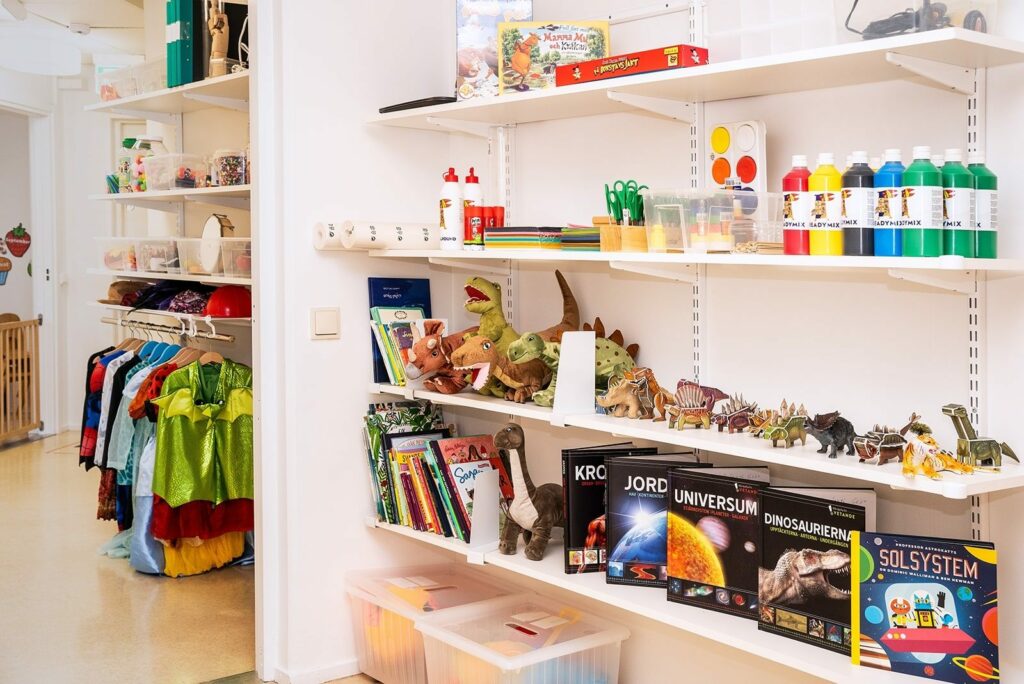
The shelves of play materials. An ordinary preschool day is full of play – your child should be able to join in.
Keep your child at home if they …
- have a fever – 38 °C or higher. Your child can come back after at least 24 hours without a fever, without fever-reducing medicine. A child who needs medicine to keep the fever down is not ready for preschool.
- are vomiting or have diarrhoea. After a stomach bug, your child stays at home until two days have passed without vomiting or diarrhoea and they are eating as usual.
- are not up to it – tired, listless and not quite themselves, even without a fever.
- have a sore throat or earache from an infection. Then your child usually needs to stay at home until the pain has gone.
It is fine to come with …
- a slightly runny nose or a mild cough, if your child is otherwise lively and well.
- allergy symptoms, which are not contagious.
- red, slightly sticky eyes in the morning that are fine for the rest of the day. If the eyes are badly infected and need wiping several times a day, your child stays at home until the eye inflammation has healed.
- pinworms. Your child does not need to stay at home, but let us know, so that we can inform the other families.

Brushes and paints in the studio. Small hands share a lot – which is why infections spread easily in a group of children.
Common childhood illnesses – when can your child come back?
The basic rule always applies: your child should be able to manage a whole day in the group and have been free of fever for at least 24 hours. Some conditions also have their own limits.
- Strep throat and scarlet fever: after at least two days of antibiotic treatment.
- Chickenpox: when all the blisters have dried up and no new ones appear.
- Impetigo: when the sores look completely dry.
- Head lice: once you have done the first treatment. Let us know, so that all families can check their children at the same time.
- Hand, foot and mouth disease, flu, RSV and COVID-19: the basic rule is enough. If your child is up to it and has been free of fever for 24 hours, they can come.
Is a condition missing? 1177’s infection guide covers more childhood illnesses (in Swedish).
If your child falls ill with us
If your child develops a fever or becomes unwell during the day, we will contact you and ask you to collect them. Until you arrive, your child can rest quietly with a teacher. If your child is vomiting or has diarrhoea, they need to be collected as soon as possible. So make sure we can always reach you, or someone else who can collect your child.
Tell us why your child is at home
Feel free to send a text message in the morning when your child is staying at home, and tell us what it is – a fever, a stomach bug or chickenpox. That way we can spot early if something is spreading in the group and inform other families, without saying which child it concerns.
Not sure?
Ask yourself: would my child manage a whole day of play, meals and time outdoors in a group? If the answer feels doubtful, one more day at home is usually the right call – for your child and for their friends.
Should we see things differently, the Public Health Agency of Sweden says it is the staff’s assessment that decides whether a child can take part. We make that assessment with your child’s best interests in mind, and we are happy to talk it through with you. If you are worried about how your child is doing, you can always call 1177 for healthcare advice.
Do you have questions about your child?
Get in touch with us in Kista or Hässelby – preferably by text message. We will reply as soon as we can.
Read more: Tears at drop-off · Outdoor time in preschool