
Updated 4 October 2026
The tablet at the breakfast table, the phone in the hallway, a cartoon while dinner gets made – screens are part of everyday family life with small children, and that is nothing to be ashamed of. Yet many parents carry a nagging sense of guilt. We would love to take that off your shoulders. For a few years now there have been clear Swedish recommendations to lean on, and they are not about judging families – they are about what small children need plenty of. The good news: you are probably already doing most of it.
What do the recommendations say – and why?
In the autumn of 2024, the Public Health Agency of Sweden published the country’s first national recommendations on children’s screen use. For the youngest, they are easy to remember:
- Under 2 years: ideally no screen time at all – a video call with grandma is fine. Not because the screen is harmful in itself, but because the youngest children learn through something it cannot offer – eye contact, voices, touch and interplay with people.
- 2–5 years: at most one hour a day, preferably less – and ideally together with an adult.
- Sleep first: screen-free time before bed, and phones and tablets sleep best outside the bedroom.
The advice is in line with the World Health Organization’s guidelines for children under five, and with what Swedish child health services (BVC) say through 1177 and Rikshandboken.
The logic behind it is not that screens are dangerous, but that the day has only so many hours. Small children need plenty of three things: conversation – language is built in turn-taking with an adult, and studies link heavy early screen use to later language development, mainly because conversations and shared reading become fewer – sleep (10–13 hours a day at preschool age) and movement (at least three hours a day according to the WHO). The recommendations are really a reminder to protect what already works: play, books, time outdoors and a good night’s sleep.
How we do it at preschool
The Swedish preschool curriculum has taken the same direction. Since 1 July 2025 there is no requirement to use digital learning tools – on the contrary, learning tools are now to be primarily analogue: children under two should only meet analogue tools such as books, for older children anything other than analogue tools is to be used with great restraint, and reading aloud, play and movement have been given a larger place.
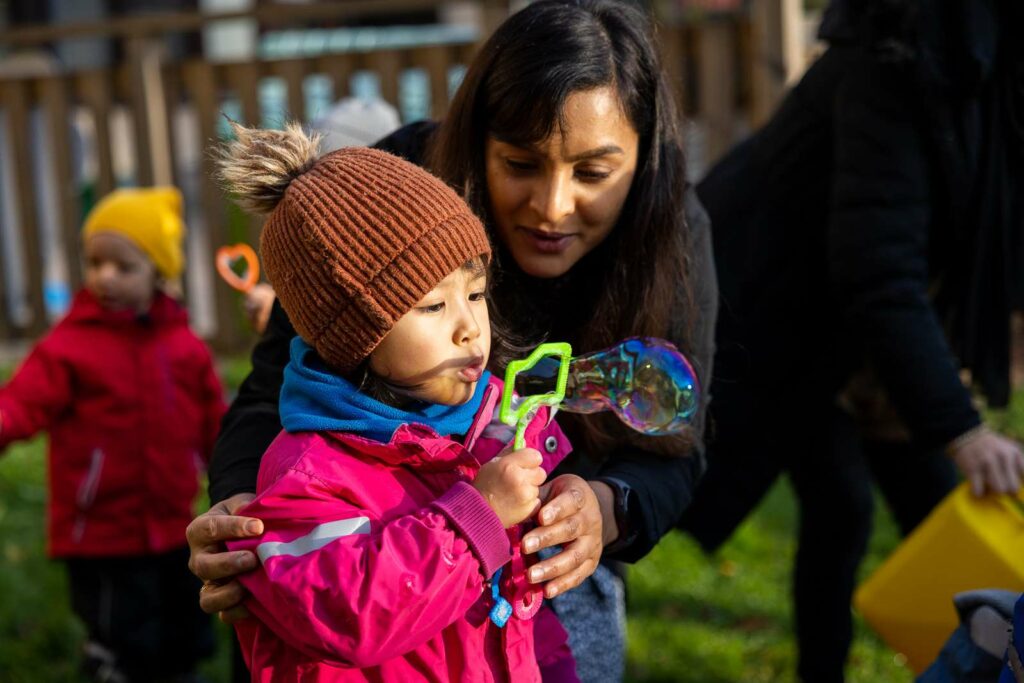
For us at Svenska Internationella Förskolan, this was no adjustment – it is how we have always worked. With us, children do not sit in front of screens. With the older children, digital tools are used only in specific projects, for example when we explore technology and science – otherwise, our learning tools are analogue. We read aloud every day in both Swedish and English, the books are always within reach, and outdoors is a classroom, not a break. This also means something practical for you as a parent: your child’s screen time starts at more or less zero when you meet in the afternoon. The hour you have to spend is entirely your own.
Six everyday habits that carry you – and that you probably already have
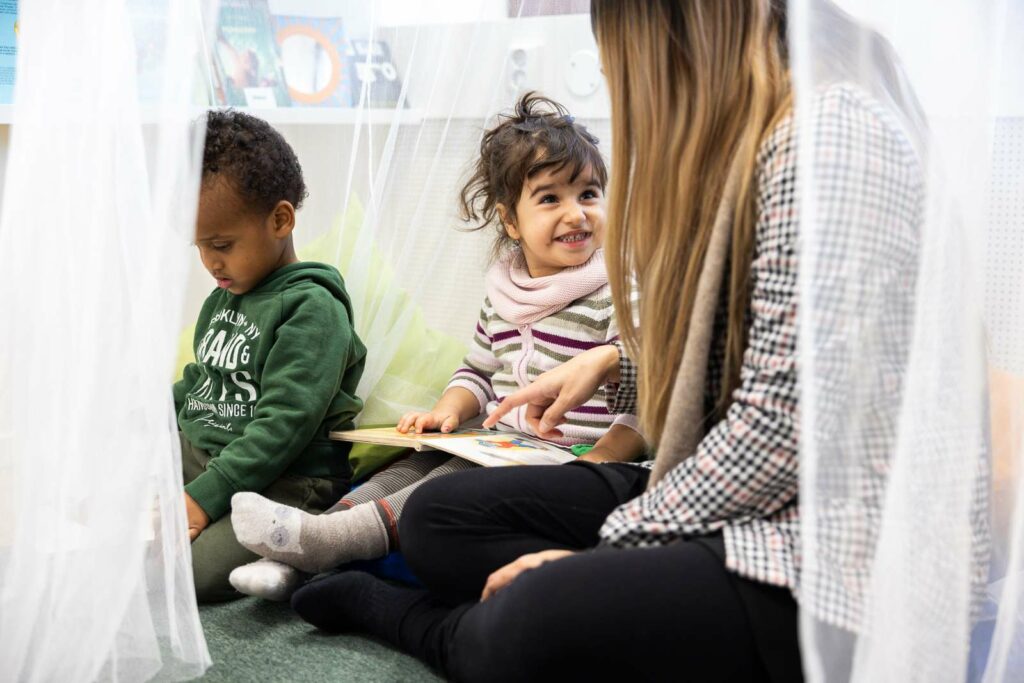
- Read a book together. Ten minutes of reading aloud is the best investment of the preschool years – and it beats any app.
- Watch together when you watch. Screen time with an adult alongside is something completely different from screen time alone: talk about what you see, just as you would with a picture book. Choose calm, age-appropriate content without ads.
- Keep meals and bedtime as screen-free islands – for the whole family. Shared rules are easier to keep than bans that only apply to the children.
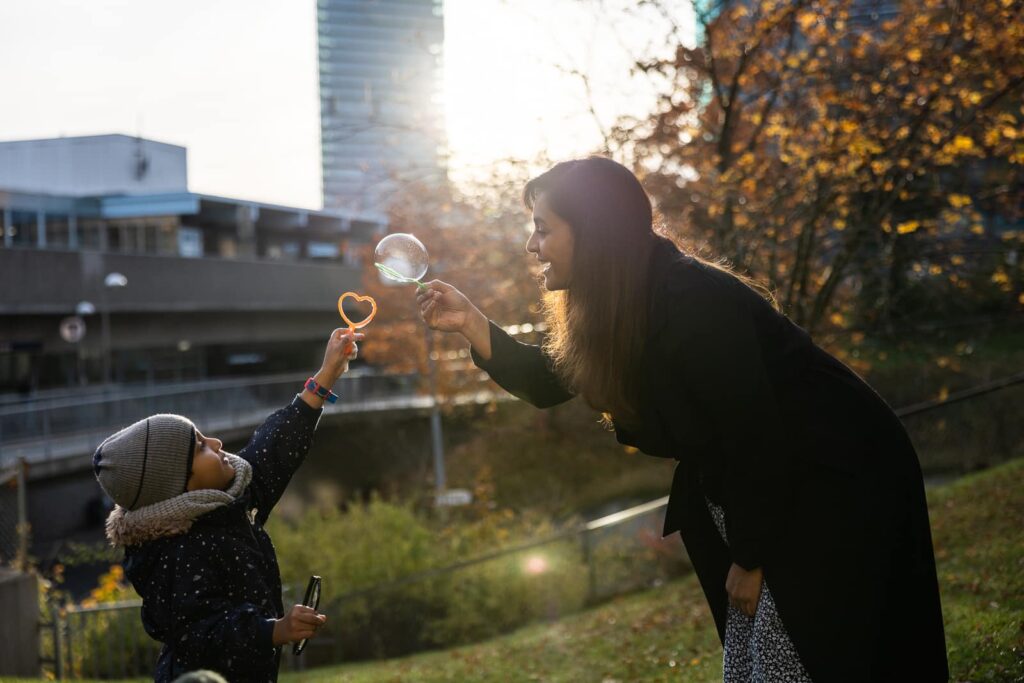
- Spend some time outdoors every day. Movement and fresh air do half the job for both sleep and balance.
- Treat yourselves to screen-free moments as adults. Not out of duty – but because playing and talking with your child is the best part of the day, and it shows when the phone is in another pocket.
- Let go of the single day. A tablet on a car journey, a sick day on the sofa or a film night sinks no one. It is the balance of the week that counts – and if one day goes sideways, a new one starts tomorrow.
In short: you do not need to be a perfect parent, and the recommendations are a support, not a report card. A child who is read to, gets to run around and sleeps well is already on solid ground – with or without a little screen time.
Read more
- Public Health Agency of Sweden: Recommendations for balanced screen use among children (in Swedish)
- Public Health Agency of Sweden: For parents of children aged 0–2 (in Swedish)
- Public Health Agency of Sweden: For parents of children aged 2–5 (in Swedish)
- 1177: Children and screens (in Swedish)
- Rikshandboken (Swedish child health services): Screen habits for children 0–6 (in Swedish)
- WHO: Guidelines on physical activity, sedentary behaviour and sleep for children under 5
- Government of Sweden: More books and fewer screens in preschool (in Swedish)
- Swedish National Agency for Education: Guide to the curriculum changes (in Swedish)
- Public Health Agency of Sweden: The research behind the screen recommendations (in Swedish)
Curious about how we work? The answer to the screen question – and much more – is in the FAQ on our preschool pages. Or book a visit in Kista or Hässelby and see an analogue preschool day with your own eyes.
This article was translated from the Swedish original with the help of AI.